
Mesh reflector for shaped radio beams
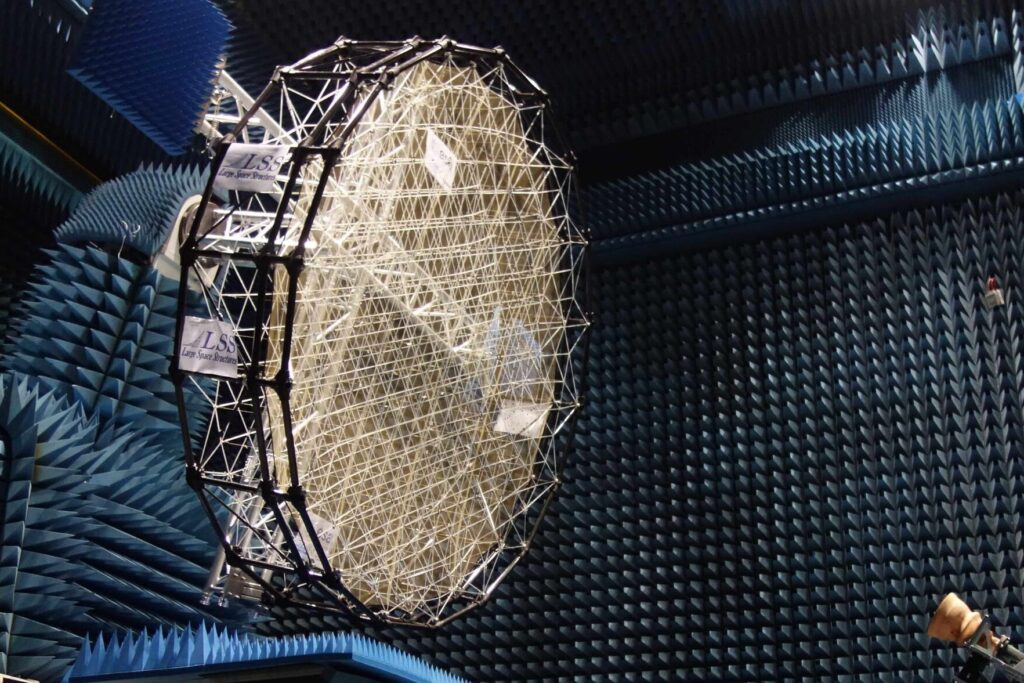
This news posting is written by esa.int This prototype 2.6-m diameter metal-mesh antenna reflector represents a big step forward for the European space sector: versions can be manufactured to reproduce any surface pattern that antenna designers wish, something that was previously possible only with traditional solid antennas. “This is really a first for Europe,” says ESA antenna engineer Jean-Christophe Angevain. “China and the US have also been working hard on similar shaped mesh reflector technology. It is needed so that sufficiently large antennas can be deployed in orbit, which would otherwise be too bulky to fit inside a launcher fairing, while also meeting required performance levels.” ESA’s AMPER (Advanced techniques for mesh reflector with improved radiation pattern performance) project was performed with Large Space Structures GmbH in Germany as prime and TICRA in Denmark as subcontractor. Antenna reflectors for satellites are often surprisingly ‘lumpy’ looking. Their basic paraboloid convex shape is distorted with additional peaks and valleys. These serve to contour the resulting radio frequency beam, typically to boost signal gain over target countries and minimise it beyond their borders. “This tailored surface shaping is traditionally done with traditional metal or carbon fibre reinforced plastic composite reflectors,” adds Jean-Christophe. “The challenge was how to reproduce such shaping using a mesh reflector design. The obvious solution would have been a conventional tension truss double layer solution, with the mesh held together tautly on an alternating ‘push and ‘pull’ basis. A smart alternative solution has been proposed and followed by the team.” Leri Datashvili, CEO and Chief Designer of Large Space Structures explains: “The design of our shaped mesh reflector is based on tension members supported by a peripheral truss structure which enables decoupling of the shaped surface and the structure. Therefore, the design can be implemented for any size of reflector, for any frequencies ranging from P-band to Ka-band. Furthermore, either deployable or fixed reflector technology can be realised.” “This 2.6-m ‘breadboard’ prototype proves the concept at C-band frequency, and the RF measurements have shown good correlation with radio-frequency and mechanical predictions” adds Jean-Christophe. The AMPER project was supported through ESA’s Technology Development Element, with prototype testing carried out in ESA’s Hertz chamber at its ESTEC technical centre in the Netherlands. As a next step the AMPER team plan to produce a deployable version, aimed at Earth observation as well as telecommunications uses.
New ESA Project DRAC
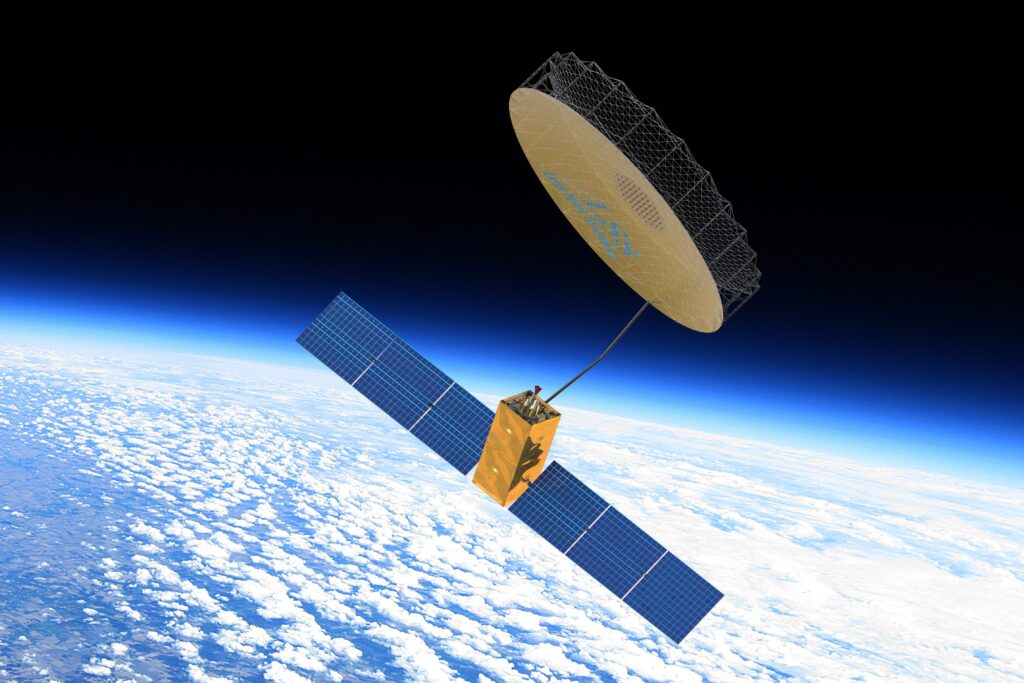
LSS has been awarded the project DRAC (Deployable Reflector Antenna for CubeSat). The objective of the project is to develop and demonstrate 1m to 3m diameter deployable reflector antennas for CubeSat applications. Large Space Structures GmbH (LSS) is a company based near Munich, Germany, founded in 2012 as a spin-off of the Technical University of Munich where its staff had been working on deployable reflectors and advanced composite membranes for more than two decades. It inherited from its academic background a very strong R&D philosophy, still developing break-through materials and technologies in partnership with various institutional, industrial and academic institutions from 0.5 m to >12 m reflectors and from P to W-band.
LSS introduces OriFlex® technology for reflector folding
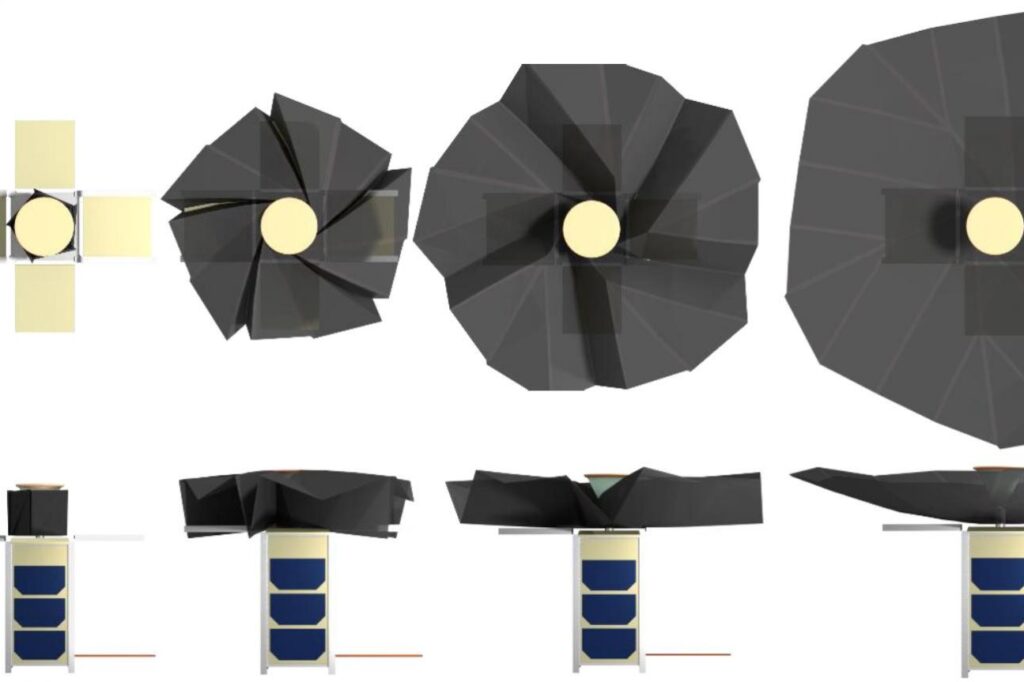
OriFlex® (origami folding of flexible reflective surface FlexRS®) is a proprietary technology of Large Space Structures GmbH for deployable reflectors based on our FlexRS® family of materials. It is designed for satellites applications, where volume is an expensive ressources and a large antenna reflector could not be launched, or would be too expensive. OriFlex® complements our other technologies of deployable reflectors, and focuses on small to medium size platforms – for reflectors of 0.5m in diameter for CubeSats, to 5m reflectors (and larger) for small satellites – for operation at L, S, C, X, Ku, Ka-bands and up to 60 GHz depending on the FlexRS® category used. The first component of the OriFlex® technology is the folding of the reflector, inspired by the Japanese art of origami – literally paper folding. OriFlex® is therefore the art of folding flexible surfaces, which allows large antenna reflectors to be folded in very small volume, and deployed after the satellite is put onto its orbit. Origami only applies to the folding of flat sheets of materials, while antenna reflectors are doubly curved. Dedicated geometrical and kinematics methodologies had to be developped, contributing as one of the very first steps in the scientific field of doubly-curved origami folding. The second component of the OriFlex® technology are novel manufacturing technique, testing and characterisation procedures of the FlexRS® materials family specially tailored for origami-like folding. Indeed, an OriFlex® reflector that is stored for months or years before its deployment may experience relaxation (somewhat also incorrectly referred to as “creep”), where the folds may form creases and the panels may keep unwanted curvature. For this reason, the folds and the panels are carefully designed and thoroughly tested with bespoke testing methods. The third aspect of the OriFlex® technology is to verify that there is no deterioration of the RF performances of the antenna system, whatever be the deformations that may result from folding and storage. This is done with numerical methods that accurately predict the behaviour of the origami reflector during and after deployment. Building on our proven FlexRS® family of reflective surface and more than 20 years of research on carbon fiber reinforced silicone (CFRS), and even more in the fields of deployable reflectors, OriFlex® technology enables low cost, high performances reflectors for applications such as CubeSats and small sats for miniGEO, SAR imaging, mega constellations, and science missions. Large Space Structures GmbH (LSS) is a company based near Munich, Germany, founded in 2013 as a spin-off of the Technical University of Munich where its staff had been working on deployable reflectors and advanced composite membranes for more than two decades. It inherited from its academic background a very strong R&D philosophy, still developing break-through materials and technologies in partnership with various institutional, industrial and academic institutions. FlexRS® is a registered trademark for Large Space Structures GmbH family of RF reflective materials. FlexRS®-I are shell membranes based on Carbon Fiber Reinforced Technology (CFRS). FlexRS®-II are gold-plated, metallic meshes with their supporting cable network. FlexRS®-III are flexible shells based on CFRS technology, for use in deployable reflectors or reconfigurable reflectors. FlexRS® -IV explore special knitting techniques, and for use up to 60GHz. OriFlex® is a registered trademark for Large Space Structures GmbH set of technologies related to the design and analysis of highly compact origami-based deployable reflectors based on its FlexRS® family of RF reflective surfaces.