
3rd Georgian International Conference 2018 on Advanced Lightweight Structures and Reflector Antennas

The 3rd Georgian International Conference 2018 on “Advanced Lightweight Structures and Reflector Antennas” will be held from 19th to 21st of September 2018 in Tbilisi, Georgia. Large Space Structures GmbH (LSS) organizes this conference in cooperation with the Georgian Technical University (GTU) with the participation of experts from the European Space Agency (ESA) for the third time. More Details can be found on the ESA conference website and in the Call For Abstracts below. Call For Abstracts (PDF, 487 KB) Conference Website at ESA
New EC H2020 Project LEA
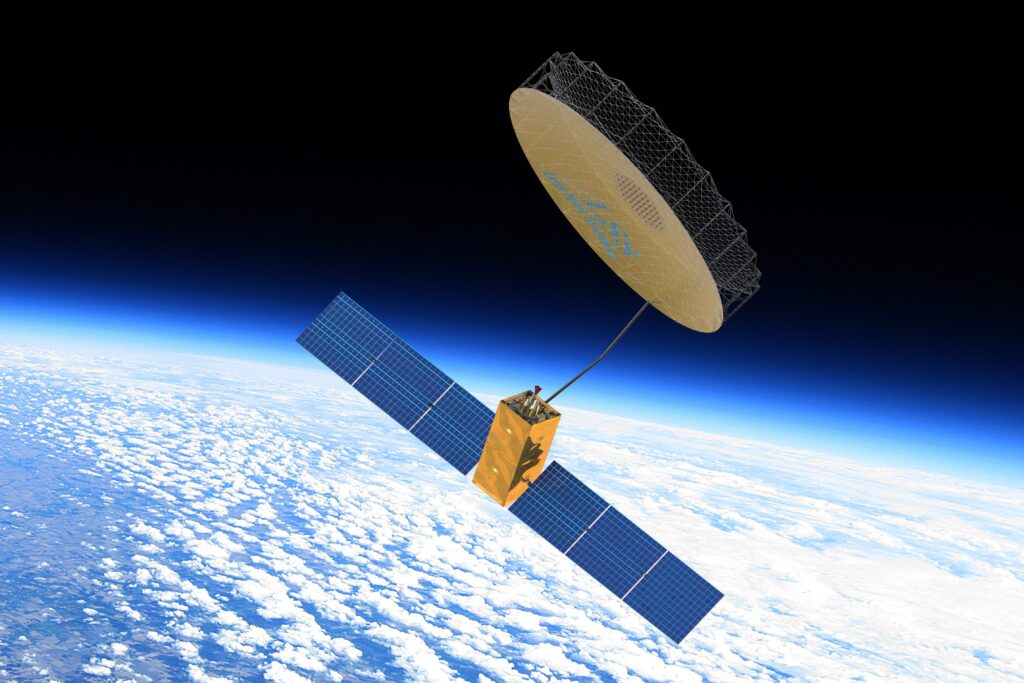
LSS has been awarded the Horizon 2020 project LEA (Large European Antenna) in a consortium of 15 European companies from 6 nations led by HPS. The project aims towards European non-dependence in large deployable reflectors. The consortium will develop a flight-ready 6m deployable reflector antenna, ready for launch from 2021. More details of this for future telecommunication, science missions and Earth observation important project can be found in the press release.
LSS Deploys Large Antenna
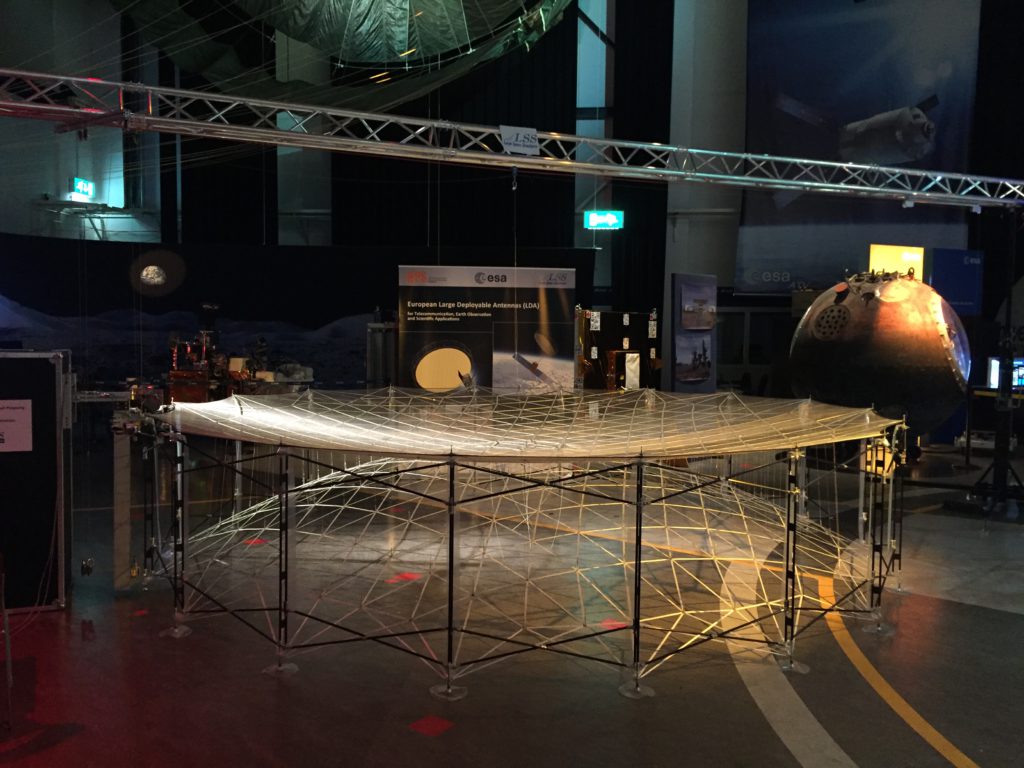
This news posting is written by Critical Comms. A test deployment has been undertaken for a 5 m diameter antenna, which is designed for orbital operations. Previously, the European industry was unable to field reflectors that were larger than 4 m in diameter. However, large reflectors are increasingly required for telecommunications, science and Earth observation missions. The reflector was developed as part of an effort addressing a full large deployable antenna system through ESA’s Basic Technology Research Programme (TRP) by a consortium led by HPS GmbH in Germany, with Germany’s Large Space Structures being responsible for the reflector and its deployment. The deployment took about seven minutes to unfold automatically into its final configuration. “This reflector has a ‘double pantograph’ design to form a deployable ring,” said ESA’s Alexander Ihle. “Once deployed, it tensions two opposing but connected parabolic nets, one on the top and one on the bottom.” The challenge is to develop a reflector that can easily be stowed within the limited space available inside a launcher fairing and then opened to its full size while remaining sufficiently stable and accurate afterwards to meet strict performance requirements, including the use of high-frequency radio signals. The top netting supports and maintains a very finely knitted metallic mesh in a predefined shape. “This mesh is what will eventually reflect the radio signal — doing the real work of the reflector,” said Leri Datashvili, Large Space Structures GmbH. The design is also scalable, both in terms of the reflector diameter and moving up into higher frequencies. Another 5 m reflector, also supported through TRP but based on carbon fibre reinforced silicone surface, was tested in ESA’s Large Space Simulator thermal–vacuum chamber earlier this year.